



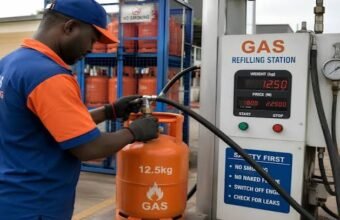
The Nigerian Midstream and Downstream Petroleum Regulatory Authority (NMDPRA) has reported an 18 per cent increase in domestic cooking gas supply, which rose to 4.5 million litres per day in September 2026 from 3.7 million litres per day in September 2025.
The Authority disclosed this in its latest data, which also showed that supply increased by 33.33 per cent from 3.375 million litres per day in August to 4.5 million litres per day in September.
Despite the increase in supply, the price of cooking gas rose by 7.14 per cent to N1,400 per kilogramme in October from N1,300 per kilogramme in September.
Former National President of the Nigerian Association of Liquefied Petroleum Gas Marketers, Oladapo Olatunbosun, attributed the increase in supply to improved local production but called for sustained investment and government support to prevent shortages.
He said: “Local production has increased, which is the reason for the result. However, there is much to be done by both the government and stakeholders to drive the development required to harness the potential of LPG.”
Olatunbosun urged the government to encourage indigenous operators and support major domestic producers, including Dangote Petroleum Refinery, to boost output and stabilise the energy market.
“The government should continue to encourage indigenous operators, and they should see it as being a partner in bringing stability to energy,” he said.
He added that increased investment in production and distribution would improve availability and make cooking gas more accessible to consumers.
“The market is wide and large, and the more we get people investing in the production and distribution of LPG, the more available the product will be,” he said.
Similarly, National President of the Oil and Gas Services Providers Association of Nigeria, Colman Obasi, described the increase in supply as positive but said consumers must benefit through improved access and affordability.
888888888888888888888888
NMDPRA Relaunches Gas Code to Expand Supply to Power
The Nigerian Midstream and Downstream Petroleum Regulatory Authority (NMDPRA) has launched Revision II of the Nigerian Gas Transportation Network Code (NGTNC) to expand access to gas transportation infrastructure for power plants, fertiliser producers and other industrial users.
Authority Chief Executive, Rabiu Umar, relaunched Code at the opening of the 20th Oil Trading and Logistics (OTL) Africa Downstream Energy Week in Lagos, following the signing of the revised code with key industry partners.
Umar said the revision was designed to deepen domestic gas utilisation and ensure open and fair access to pipeline infrastructure, providing clearer rules for producers, shippers, transporters and buyers.
“The Network Code basically is the rulebook for gas transportation. As we know, there’s one pipeline that different producers put their gas into. And for there to be equity, there needs to be a code, or if you like, rules of engagement on how you put your gas inside, how the gas is measured, and how you nominate gas.
“The pipelines deliver their full value only when access to them is open and fair. It is therefore a pleasure to announce, as you have witnessed, that the Authority has officially launched the revision 2 of the Nigerian Gas Transportation Network Code,” he said.
He said the revision built on gains recorded under the earlier framework, which has encouraged more shippers to use the network and improved the management of gas flows.
He hinted that since revision 1, more shippers have come onto the network, and the imbalance on the Western network has fallen by about 30 per cent.
He said that Revision II builds on the gains, while inviting shippers, transporters, and investors to make full use of the window.
The revised code also introduces provisions to address gas losses arising from incorrect injection into pipelines, including clearer rules on shrinkage factors.
Umar said the framework would support improved utilisation of existing infrastructure as Nigeria works to increase gas supply to domestic industries.
He disclosed that the Oben-Obiafu-Obrikom (OB3) pipeline and the Escravos-Lagos Pipeline System midline compressor were nearing completion, while the Ajaokuta-Kaduna-Kano gas pipeline was more than 80 per cent complete.
According to him, the projects are expected to increase the country’s gas transportation capacity from 2.2 billion cubic feet per day to 4.4 billion cubic feet per day when completed, helping connect gas supplies in the south to demand centres in the north.
Umar said about three-fifths of the gas processed in September went to power plants, factories, Nigeria LNG and the West African Gas Pipeline, while demand for cooking gas continued to exceed supply.
He said the revised code also provides initial rules for regional gas pipelines, including the West African Gas Pipeline and proposed Trans-Saharan and Trans-African pipelines, with harmonised standards needed to facilitate cross-border gas movement.
Nigeria has about 215 trillion cubic feet of proven gas reserves, while the country requires substantial new investment in processing and transportation infrastructure to unlock its potential.




No Comment! Be the first one.